
In November, when the leadership of America’s military was not preoccupied with striking alleged drug smugglers on the high seas, it saw fit to release an acquisition strategy intended to ‘rebuild the arsenal of freedom.’ Like the broader political moment, the strategy is marked by a mix of bluster, bureaucratese, and the occasional bold insight. It aims to strengthen the industrial base from which America draws its might by attracting new suppliers and capital to deliver innovative weapons faster and at scale.
Without fundamental change, America’s military is at risk of losing its ability to deter and win a conflict. Its systems are aging: its fighter fleet and warhead stockpile average roughly thirty years old. It must move faster to embrace emerging technologies. And it must be able to produce and maintain them, reversing bottlenecks and backlogs, spanning from munitions to submarines, that could prove consequential in a prolonged conflict. America is not a paper tiger, as Mao once charged, but it is increasingly a rusting and brittle one.
Eyck Freymann and Harry Halem, China and military analysts, respectively, have written a comprehensive examination of what it will take for the Pentagon to deter a conflict with China. It is not enough to have a technological edge or superior numbers, but, as they put it, “the capacity to keep adapting.” In dedicated chapters, the authors examine capabilities including surveillance and reconnaissance, the surface fleet, and space, detailing their importance, current misalignments or deficiencies, and proposed reforms. They largely succeed in writing a work that is both broadly accessible and admirably balanced in its assessments.
The Pentagon, with the help of Congress, will need to spend more, better, and differently. It will also require broader efforts to revitalize the broader manufacturing sector. And policymakers mustn’t ignore the potential for investments in Taiwanese resilience and diplomacy — with allies and China — to buy down risk.
Spending more and better
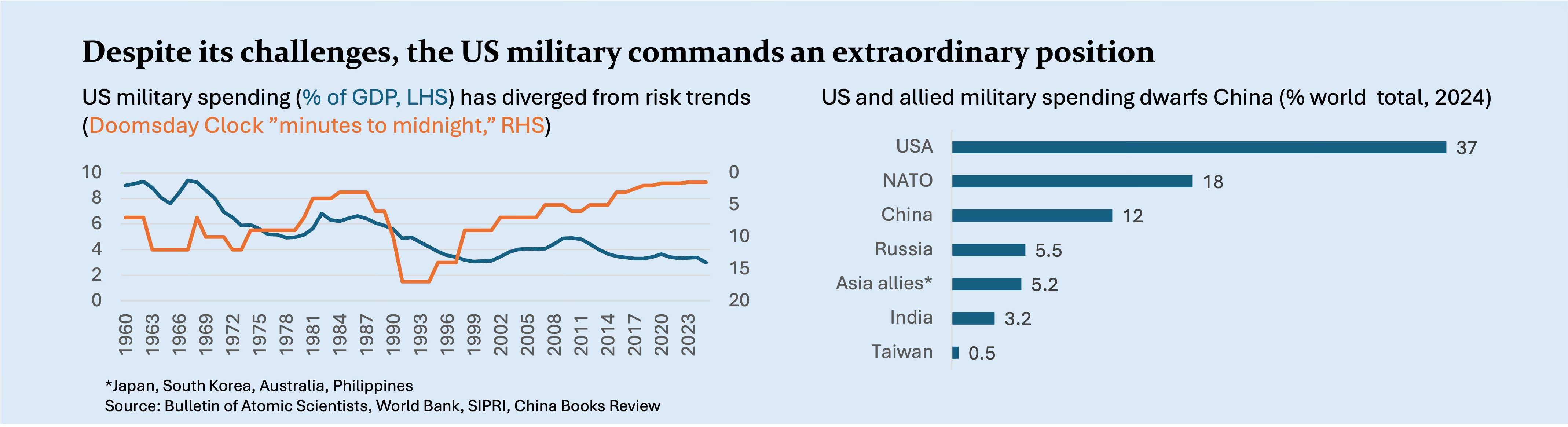
The United States spends extraordinary sums on its military, nearly $1 trillion in 2024, 13% of all federal spending, more than half of non-entitlement federal spending, and 37% of the world’s total. And yet, Freymann and Halem credibly make the case that the government must spend more even as it shifts its allocation on what it spends, cutting some expensive platforms that would not help win a conflict with China, while investing heavily in cheaper, autonomous platforms that it can afford to lose en masse.
As a share of GDP, US defense spending stands at 3.4%, postured as if the world was still in a relatively benign post-Cold War environment, despite the return of a systemic competitor which prompted spending in the 1980s at levels north of 6%. Where America’s obligations span the globe, China’s are concentrated in its home region. In a rationally designed force, Freymann and Halem write, “one would expect to see significant variation between service budgets in both absolute and relative terms outlays over time, as the Pentagon adapts to new threats. In fact, the opposite is true.” Even though any conflict with China would be “primarily an air-naval war,” the services’ budget allocations are nearly identical, which “suggests a bureaucracy on autopilot.”
No legacy platform provokes greater anxiety than the aircraft carrier, the core of American power projection globally. Despite concerns about China’s improving ability to target them with weapons like hypersonics or overwhelm them with drone swarms, Freymann and Halem take a more moderate stance, believing that a combination of investments in air and missile defense, directed energy weapons, and railguns can maintain their survivability. The authors do, however, support the already announced retirement of the Littoral Combat Ship and cancellation of the Constellation-class frigates as the type of overdue rationalization the military needs. They point out that American nuclear-powered submarines will continue to grow in strategic importance, but are plagued by delays in repair and construction.
Unmanned systems, in the air, on the ground, and on and under the sea are also poised to play an ever greater role in combat. Strategists envision cheap, mass-produced systems that would overwhelm limited and more expensive defenses serving alongside more sophisticated autonomous and human-powered platforms. The challenge for the United States is that China dominates the consumer drone market that would be repurposed for military use. Freymann and Halem are supportive of bans on Chinese commercial drones and drone components to jumpstart an allied industry, but note this is only the first step in a challenge that will require leading artificial intelligence and electronic warfare capabilities. Even as the United States invests heavily in these new platforms, it cannot ignore its legacy commitments. Modernization of America’s nuclear arsenal is expected to cost $1 trillion alone.
Spending differently
How the military spends matters just as much as how much and on what it does. Budgeting and procurement processes themselves can have a profound effect on America’s ability to arm itself. Reform would come in the form of longer-term budgets, outcomes-focused payment models, and processes that reward innovators who can deliver instead of those most adept at navigating bureaucracy. Such a change has been long recognized. In 2002, then Secretary of Defense Donald Rumsfeld called for a “more entrepreneurial approach to developing military capabilities, one that encourages people … to behave somewhat less like bureaucrats and more like venture capitalists.” The inertia that must be overcome is formidable.
Start first with Congress. Seemingly content to yield its authority on almost all other matters, the legislative branch nonetheless regularly overrules the military’s budget requests with its own judgements, coupled with a determination to spread the Department’s largesse as widely as possible. The frustration directed towards the clubby group of prime contractors is conspicuously not matched by scrutiny of the $150 billion in direct and indirect contracts to small businesses. Size is not a proxy for the ability to innovate and works against the imperative to scale innovation faster. The inability to pass a proper budget injects uncertainty into supplier decisions, conspiring against speed and scale while adding further cost. Multi-year budgeting is often positioned as one of the most needed reforms. Proponents argue it would not only reduce the costs of uncertainty to suppliers, but enable the financial sector to step in with more and cheaper capital.
Alas, multi-year budgeting may increasingly be out of step with the accelerated tempo of competition with China. A new generation of defense tech companies, led by Anduril, seek to upend the military’s traditional procurement model. Instead of reactively building products based on military specifications in a cost-plus model, Anduril believes that companies should assume the risk of financing their own research and selling products “off the shelf” to meet anticipated mission needs. The company points to what SpaceX has achieved in dramatically reducing the cost of rocket launches as an example of this approach. In this world, not only fixed price contracts, but “as-a-service” models would reign. (Imagine the counterfactual in which expenditure on the F-35 fighter jet was made based on uptime, a notorious deficiency.) Contracts of meaningful size and duration would be balanced by more frequent competitions for renewal. Freymann and Halem agree that a venture model can work well for unnamed systems and sub-systems of traditional platforms, but argue the model would be inappropriate for large systems like surface ships and submarines that “involve enormous capital expenditure, high unit costs, ongoing maintenance, and complex supply chains.”
Even such a revolution in procurement might still be a step behind where competition is headed. As a retired general recently put it in conversation with your correspondent, the Pentagon needs to be able to make a hundred thousand drones on command, but not a minute before they’re needed. Inventory becomes synonymous with obsolescence, which can only partially be mitigated by the greater importance of software, which can be more rapidly updated. While the authors do not explicitly propose a financial mechanism to solve this inventory paradox, one idea would be for the government to consider a kind of “catastrophe bond.” Today, these instruments are used by countries who pay a coupon to investors who agree to forfeit their principal if a prespecified trigger, such as a hurricane of a certain magnitude, occurs. In a defense context, this might look like the Treasury being authorized by Congress to issue bonds whose principal, if a trigger is met, would be pre-committed to a producer. Indeed, the likeliest counterparty might be the prospective manufacturer themselves.
Spending apart
The most significant assumption that Freymann and Halem make is that it is possible for the Pentagon to reform itself. Policymakers should hedge against that risk. For all its power, what the Pentagon most lacks is the power to truly transform itself. It is unwise to believe that the significance of the challenge of deterring China will be what it takes for this enormous bureaucracy to right itself. Among the recommendations offered by a commission of defense experts convened by Michael Bloomberg was the creation of a Deputy Secretary of Defense for Future Operations. The proposal is not bold enough. A steady procession of initiatives, including the Defense Innovation Unit and Office of Strategic Capital have made a difference on the margins, but they will always be limited by their lack of scale.
Looking beyond the authors’ solutions, true reform may require the establishment of an entirely independent Special Branch, that would serve as a model integrated force focused on future warfighting. The United States for many years set the ability to fight two simultaneous conflicts as its governing model. A version of that model merits return, perhaps reframed as the goal of America maintaining two ‘top three’ militaries. (Russia, the current third, spends an estimated $150 billion annually, a similar order of magnitude to America’s individual branches.) Having established the Space Force in its first term, the second Trump administration would be well-positioned to build on that precedent.
While the traditional branches reform their processes and manage the simultaneous balancing of legacy and new capabilities, the Special Branch would be designed from the start to test and deploy new products quickly. Even if the traditional branches only partially succeed in accelerating their tempo, they can rely on the Special Branch to have proven the readiness of a new system and built an industrial base ready to ramp up production if the legacy branches choose to adopt it. In the same way that China once transformed its economy by growing out of the Five-Year Plan, the United States may need to transform its military by growing outside the traditional Department of Defense.
Spending beyond the military
The strength and capability of a country’s military is integrally linked with the strength and capability of a country’s overall economy. The history of the military driving research that seeds broader innovation across the economy is well appreciated. Less so is how the competitiveness of the broader American innovation and manufacturing ecosystem not only fiscally underwrites the military, but creates the latent capacity that can be converted to military uses if needed.
These pages have previously supported expanding the Civil Reserve Air Fleet concept to other domains. In that arrangement, the Pentagon contracts with airliners for the right to use their fleets in an emergency. A similar arrangement for other technologies, such as robotics, would support their adoption and improve broader industrial competitiveness. Alternatively, the government could acquire certain dual-use technologies and lend them out for commercial use, with the option to repurpose if the need arose. The Pentagon could also require its contractors to pre-identify and develop conversion plans for civilian companies that have the potential to step in as an alternative or scaled-up source of inputs. This needn’t be done for the entirety of a platform’s components. A minimum threshold of a platform’s value or number of components, across a sufficiently broad number of platforms, would balance preparedness and cost.
A recurring theme of Freymann and Halem’s analysis is the crippling impact of an aging, undertrained, and underpaid workforce. These challenges are real, but secondary. If contracts placed greater emphasis on on-time deliveries, compensation would adjust to attract, retain, and motivate a workforce. Workforce challenges call out for investments in automation that a more rational procurement system can help facilitate. Residual talent gaps can be addressed by permissive permanent and temporary skilled immigration.
Spending on diplomacy
Trump administration officials often repeat the phrase that “America First does not mean America alone.” America’s Asian allies Japan, Australia, South Korea, and the Philippines collectively spent $143 billion on their militaries in 2024, a good way towards half China’s estimated spending of $314 billion. The Trump administration has stepped back from the Biden administration’s interest in shifting America’s “hub and spoke” alliance system into a more interconnected “latticework.” It has also upended a generational effort to cultivate closer ties with India. But it has done good too. Affirmations of support for the Biden-era nuclear submarine deal with Australia and a new submarine agreement with South Korea are significant contributions to regional deterrence.
While some Biden-era officials now call for an outright Pacific defense treaty, a more realistic goal for the next internationalist administration would be to extend NATO’s mutual defense obligations to members’ territories in the Pacific. And they should remember the late Secretary of Defense Ash Carter’s call that entering a Pacific free trade agreement would be as useful strategically as another aircraft carrier.
Ongoing efforts to reform the foreign defense sales process can further support the industrial base’s pursuit of durability, efficiency, and scale. Already, foreign sales of more than $300 billion in 2024 provide a meaningful supplement to the Pentagon’s own $445 billion in procurement spend. To what extent countries seeking to diversify their reliance on American platforms is offset by the sheer increase in their expected spending remains to be seen. But it is also important that the United States not only be a seller: it can and should strategically procure from allies when they offer competitive solutions, not only because it spurs American firms to redouble their competitiveness, but also because investing in allied industrial bases creates both redundancy and advances the objectives of greater burden-sharing.
Despite concerns that President Trump will unilaterally rewrite America’s Taiwan policy in pursuit of a grand bargain with Beijing, he confronts a powerful array of interests committed to the status quo. For every sign of drift, such as Taiwanese President Lai Ching-te’s canceled transit visit through the United States, there are still signs of assurance, such as Trump’s signing into law a measure intended to set the stage for deeper official engagement with Taipei. Of greater concern is the predominant focus on spurring Taiwan’s military to invest in survivable and mobile assets intended to deter an invasion. If a blockade is more likely, it is the severe deficiencies in Taiwan’s energy and food self-sufficiency that matter more. Addressing a reliance on imports for more than 90% of its energy and 70% of its food needs would do as much, if not more, to buy down risk as any incremental dollar invested in defense. One wishes that the authors, fixated on “an age of hard choices,” called out some of these easier ones.
Deterring China should never preclude diplomacy. Freymann and Halem are right to suggest that “even though China has not shown interest in nuclear arms control, the United States should be open to exploring mutually beneficial arms control agreements.” Even with the considerable fundamental and structural sources of tension in the relationship, there remain meaningful opportunities to better manage them.
Spending now
Notably, Freymann and Halem’s book does not include a dedicated section on offensive and defensive cyber operations. China will continue pre-positioning itself to cause disruption to the American homeland, both to undermine domestic morale and undercut mobilization. Efforts to strengthen cyber resilience merit equal consideration alongside their prioritization of munitions, unmanned systems, and submarine construction and maintenance.
No effort to advance American security is currently more urgent than reducing America’s critical minerals dependence on China. Beijing’s willingness to impose export controls threatens disruption not only to the production of weapons systems, but the broader civilian economy. The US Geological Survey has estimated that even a 30% supply shock to any one mineral could cause impacts to GDP of 2-3%. The Trump administration has acted with considerable determination, making bold industrial policy interventions, such as direct equity and offtake agreements, to address market failures.
Yet, there is a risk that, even if successful, this crash program will distract the military from the need for broader reform. Instead of allowing itself to be consumed by individual projects and transactions, the government should do what it does best: set the rules of the road and align incentives. With congressional support, the administration should set clear content requirements; leverage authorities to exempt companies from antitrust restrictions in achieving them; oversee minimally necessary permitting processes at the fastest possible times; make stockpile commitments that serve as a steady source of demand; provide tax incentives that reward successful production and delivery of US-financed, -produced, or -processed critical minerals over time; and fund research that can unlock step changes in efficiency or reduced demand.
Indo-Pacific Commander Admiral Paparo has warned that the US military operates on “increasingly thin margins for error.” The military knows it must reform. Until civilian industry engages and voters demand reform, those margins will only grow narrower.